
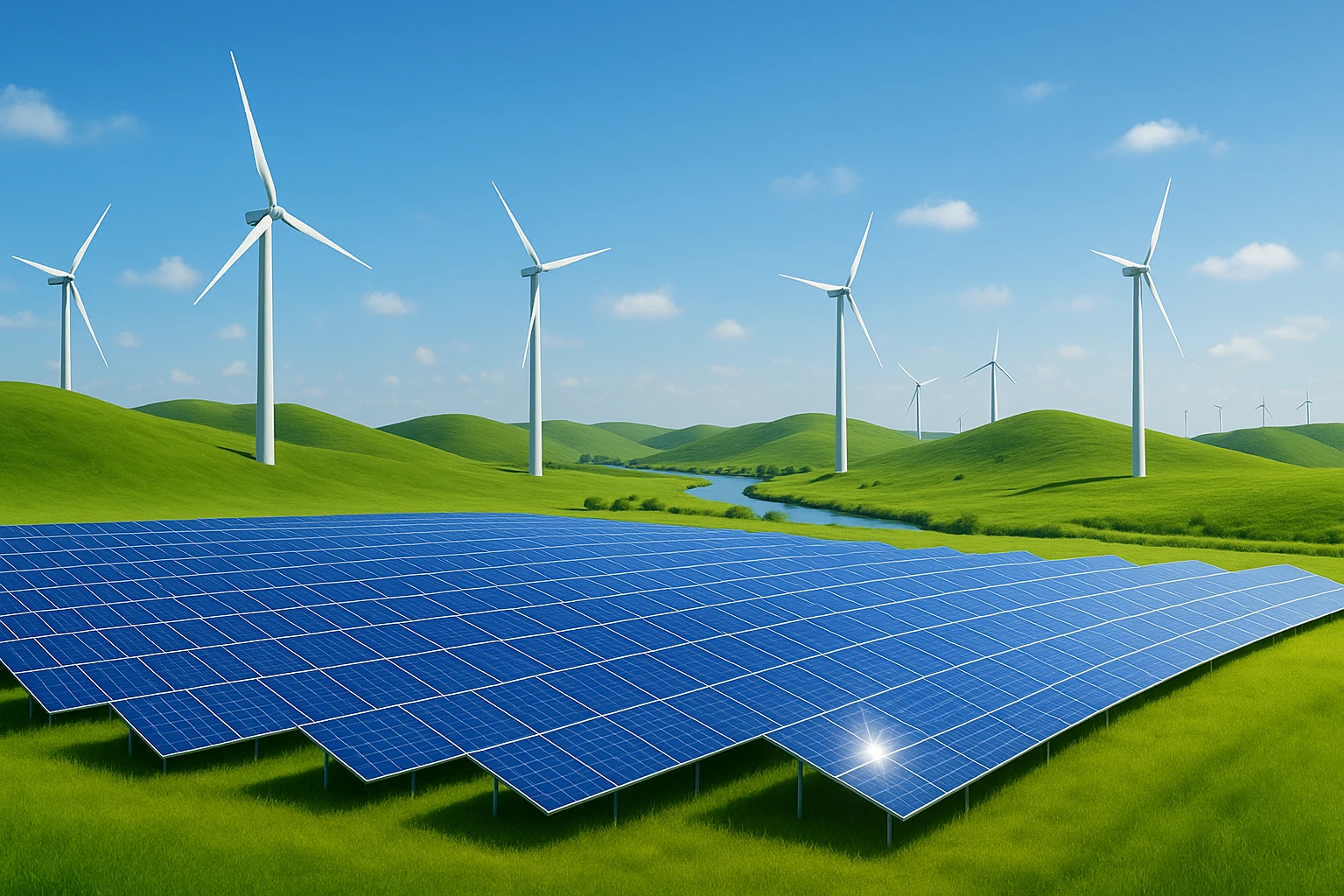
Data Centers Running on 100 % Renewables
Data centers are becoming the proving ground for what a fully renewable future looks like in practice. As global demand for digital infrastructure explodes, leading tech companies are demonstrating that even the world’s most energy-intensive facilities can run clean, reliably, and around the clock. Their shift to 100% renewable power marks a decisive step in decoupling digital growth from carbon emissions.
As global data traffic doubles every two years, data centers have become one of the fastest-growing sources of electricity demand. Once notorious for their heavy carbon footprint, the industry is now reinventing itself as a proving ground for renewable innovation. The leading hyperscale operators — Google, Microsoft, Amazon, and Apple — are achieving what many thought impossible: running mission-critical digital infrastructure on 100 % renewable power, 24 hours a day.
This transformation began with long-term Power Purchase Agreements (PPAs). By contracting directly with wind and solar developers, tech firms guaranteed both revenue for new clean projects and a fixed green supply for their facilities. Google alone has signed over 7 GW of renewable PPAs across three continents, making it the largest corporate buyer of clean energy in the world. Microsoft complements this with its “24/7 Carbon-Free Energy” initiative, matching every megawatt consumed to real-time renewable generation.
The shift is not only contractual but deeply technical. Many new data centers integrate on-site solar arrays, battery storage, and grid-balancing software that can throttle non-critical processes during energy-scarce hours. In Iceland and Finland, naturally cool climates and geothermal resources further reduce energy use — achieving Power Usage Effectiveness (PUE) ratios below 1.1, the current gold standard.
To enhance transparency, blockchain-verified energy tracking systems are being introduced. These platforms timestamp every kilowatt-hour of renewable input, allowing customers and regulators to audit carbon-neutral claims with absolute precision. The result is a new model for digital accountability — where every byte processed can be traced to a clean energy source.
The economic and environmental impact is profound. By decoupling data growth from carbon emissions, the sector demonstrates that scaling technology does not have to cost the planet. Thousands of smaller co-location and edge facilities are now following the same path, often powered by local wind farms or community solar cooperatives.
In the coming decade, the convergence of AI computing, cloud infrastructure, and renewables will only deepen this trend. Data centers will evolve from energy consumers into active grid participants — storing, redistributing, and stabilizing renewable power in real time. The digital backbone of the world is finally learning to sustain itself, cleanly and continuously.